Yoga and sustainability
2022 has seen record temperatures across the world. Europe had a searing summer, the UK saw water restrictions after its lowest rainfall but warmest summer to date. The world in the wake of post pandemic climate change. When we shut down, we saw a glimmer of possibility for our habitat, we slowed production, realized we needed each other more than material things. We barely took a breath before it was business as usual, mass production, fast paced living and we are back where we left off. Temperatures are sky rocketing, water increasingly scarce and we are too busy to pay proper attention. I think we are in trouble.
Responsibility
Yoga’s evolution has been vast and global and has travelled far from the mind yoga of its beginnings, far from the spiritual immersion of its origins. In the west it is now synonymous with health, mindfulness, and wellness, an expanded form of fitness that includes the concept of ethics and awareness. We love to harp on about the word” Yoga” meaning “to yoke”, connecting the individual consciousness to the universal consciousness, a non-duality that not only unifies the components of the human body, heart, mind, and head, but extends to the unifying all sentient beings. Connected to a deeper sense of self, a greater divinity, and earthly community. A wholistic practice that explores wholeness: our connection to all things.
We have retained some guiding principles, albeit a case of creative selection, holding dear a handful of ideas from volumes of knowledge which form some of our base principles. These also make for poetically themed classes. A standard favourite is Ahimsa, non-violence, taken from the Niyamas, which serve as a code of conduct, guidelines for living. Avoiding violent actions, thoughts, and words. To live compassionately with reverence for all of creation.
This practice of yoga has been processed and twisted and contorted and reimagined, and it is booming. Supposedly all you need is a body and breath to practice but, yoga in a modern world does not come cheap. It has been capitalized and organized into businesses and institutions, some good, some bad, some middling. But here we are. It’s a big subject, this physical practice, where we move, breathe sprinkle mindfulness dust, and then grab an organic smoothie in a disposable cup adding to the landfill.
Yoga Industry
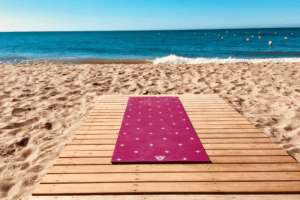
Yoga is a robust industry, one that has an estimated current worth of $34.7 billion dollars, and at growth rate of 9.6%, it is expected to reach $66.2 billion by 2027. We have yoga pants, tops, props, incense, palo santo, essential oils, singing bowls and our prayer flags are billowing in the hot wind emanating from heated, humid studios.
This is face of mainstream yoga and certainly not the whole story.
The Power of Props
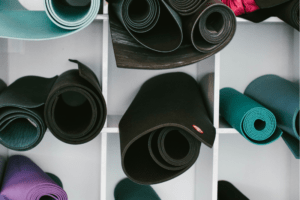
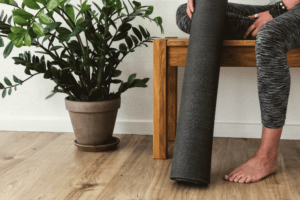
The yoga mat has been called “one of the most ubiquitous symbols of yoga’s commercialization”. It has become such an integral part of a class that we have ceased to think of it as a prop. Perhaps this should inform our approach to all props. The non-slip mat first made its appearance in 1980’s, introduced in the form of carpet underlay cut to size which quickly went on to become an official product in the form of a sticky mat. Until then grass and cotton mats or animal skins had sufficed, but as the physical focus of asana increased so too did the need for a firmer surface. We have moved away from the PVC of its earlier incarnations to far more durable, sustainable, and biodegradable products, which is positive. With so many on the market, I would encourage you to choose your mat wisely and ethically, find one that that it does not quickly need replacing.
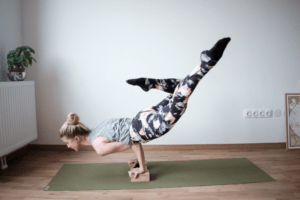
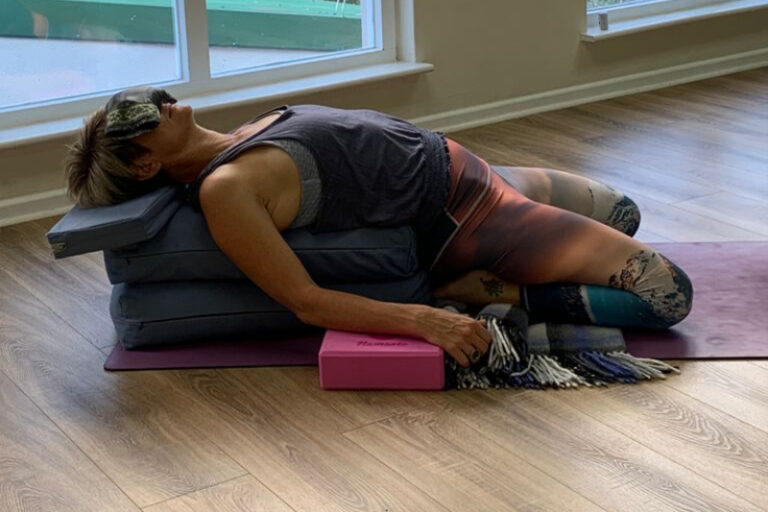
The styles of yoga I love and teach embrace props as offerings of support and hope and not objects to indicate a yoga poverty. Props can intensify, amplify, they can ease and/or inform a shape and props can make yoga accessible.

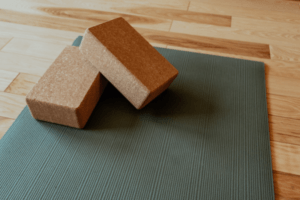
And many things can be used as a prop, however it generally props refers to blocks and bolsters. The wooden block is infinitely less toxic to the world than the foam block, and the cork block trumps the wooden block unless of course your wooden block is sustainably created and thoughtfully sourced. I am lucky enough to have a clever friend and neighbour whose ethos aligns with mine and who makes sturdy, high quality sustainable products using local materials. Sattva Yoga gear makes blocks from local pine, straps from 100% cotton webbing manufactured here in SA and the fabric used for the bolsters is pleasing to the eye, superbly durable and filled with up-cycled cotton waste. Sattva Yoga Gear are my go to prop supplier. https://www.sattvayogagear.com

A good prop which is one that is locally sourced and created and will stand the test of time. The need for perpetual replacement of things is, as we know, fundamentally problematic. Aparigraha, non-possessiveness, non-greed. Only that which you need.
Enter yoga wear.
Conscious Clothes
The Yinsters are less fashionistas than their yang colleagues. The Iyengars are casual and if you practice yoga in an ashram, please don’t wear lycra. Vinyasa is the dominant style of asana in the world of commercial yoga, and this crowd have embraced spandex leisure wear with open arms and hearts. Spandex is now a quintessential part of the commercial yoga tool kit.
I admittedly own many lycra pants (yes, I am that person), they make movement easy, but much to my horror, spandex attire is a special sort of polluter. Not only is the road to manufacturing filled with earth pain but each time they are washed, microplastic is released into the machine which is then filtered into the ocean. With every wash!
Even the recycled pants which are made from PET bottles, are not much kinder. While it does reduce the number PET bottles in a landfill, the process is water intensive, dye intensive and currently SA does not have the technology for the manufacturing process which adds a layering of carbon footprint. PET bottles can theoretically be recycled indefinitely, but manufactured clothing closes the loop ending the cycle and spandex is simply not biodegradable. You will need to wear your athleisure to death, but please don’t be buried in it, for it will outlive your corpse and pollute the earth. Cremation might work. Hemp and cotton are great alternatives for kinder living, but please ensure they locally sourced and made, and haven’t flown across the earth to find you. Bring on the flowing cotton or hemp, organically grown, fair trade, local, dye-free, drawstring pants!
Perennial Summer
Lycra pants make the need to sweat like we have run marathons at the equator a more comfortable feat than having cotton pants cling to wet skin. Hot yoga was initially created by the charming Bikram Choudry to mimic the heat of India, and while Bikram has now politically morphed into hot 26, hot yoga is part of his legacy and a mainstay in studios. In tropical places hot yoga simply means closing the windows and utilizing natural heat, which is not only cost effective but energy efficient too, unlike the crazy financial and environmental costs of heating a studio, particularly in the middle of a European winter. Every degree above 20 consumes 3-5% more energy, and with the average class being heated somewhere between 30 -45 deg Celsius it is fossil -fuel hungry.
There are however alternatives, (other than the obvious unheated yoga) I know of one studio that had humble beginnings in a cold icy Johannesburg room using gas heaters, but nowadays we have the marvels of infrared. Infrared heat is one of the most efficient ways to heat a room. It uses an invisible electromagnetic light which heats the objects and not the air. Not to objectify to people, but infrared will heat the peeps and the more people there are in the room and the more they move, the hotter it gets. Intelligent heat.
Our studio uses infrared heaters. Our studio with its warm room is the warm bright heart of the community it serves. https://theyogacollective.co.za
Sustainability
There are environmental upsides to yoga, like all things earthly, there are no absolutes. The practice teaches union and interdependence, offering hope that as we broaden our experience of self we can shift our consciousness, subsequently making ethical choices. It start to arise in support of healthier living then expands to communal, responsible, and grounded choices which hold nature and its harmony in reverence.
So choose wisely, buy consciously, buy local, support your own community and buy less. We are responsible to and for each other and are part of this earth on which we live. Unity. Individual consciousness yoked to universal consciousness. This is Yoga